
Terms of Use - Radio & TV Guide
All users who register for an account or download files must agree to the terms expressed on this page. By using this site, you automatically agree to these terms.
» If you have any news, updates, additions or corrections... e-mail them to [email protected].
Radio Broadcasting Information
FM and AM radio stations are listed as tower height above average terrain (HAAT) in meters (converted to feet), power in kW, antenna type (i.e. directional or non-directional), class licensed and longitude & latitude (degrees/minutes/seconds) of tower location.
The FCC (Federal Communications Commission) defines the following classes:
FM Station Classes
NOTE: Low-power FM (LPFM) radio services, which was created by the FCC in January 2000 are authorized for noncommercial educational broadcasting only (no commercial operation) and operate with an effective radiated power (ERP) of 100 watts (0.1 kW) or less, with maximum facilities of 100 watts ERP at 30 meters (100 feet) antenna height above average terrain (HAAT). The approximate service range of these stations is 5.6 kilometers (3.5 miles radius).
MSA vs TSA
* Metro Survey Area (MSA)
Includes a city (or cities) whose population is specified as that of the central city together with the county (or counties) in which it is located. The Metro also includes contiguous or additional counties when the economic and social relationships between the central and additional counties meet specific criteria. Arbitron Metros generally correspond to the Metropolitan Statistical Areas (MSAs) defined by the U.S. Government's Office of Management and Budget. They are subject to exceptions dictated by historical industry usage and other marketing considerations.
** Total Survey Area (TSA)
A geographic area that encompasses the Metro Survey Area and may include additional counties located outside the Metro which meet certain listening criteria to Metro-licensed stations.
The predicted distance for a FM station city grade signal is the 70 dBuV/m or 3.17 mV/m contour line and an AM station is 5 mV/m. There are several variables that determine these lines.
Television Broadcasting Information
TV stations are also listed by HAAT in meters (converted to feet) feet and power in kW. US channels with call letters with numbers in them (i.e. K22AA) or with -LP or -CA suffixes are low-power TV (LPTV) stations. They are restricted in their coverage area. US channels with a -DT suffix are digital TV stations. These new digital channels are not viewable without a digital TV set or an adapter on your current set.
TV Station Designations
Boosters vs Translators
Rebroadcast the signals of full service stations on the same frequency as the parent station (boosters) or on a frequency different from the parent station (translator).
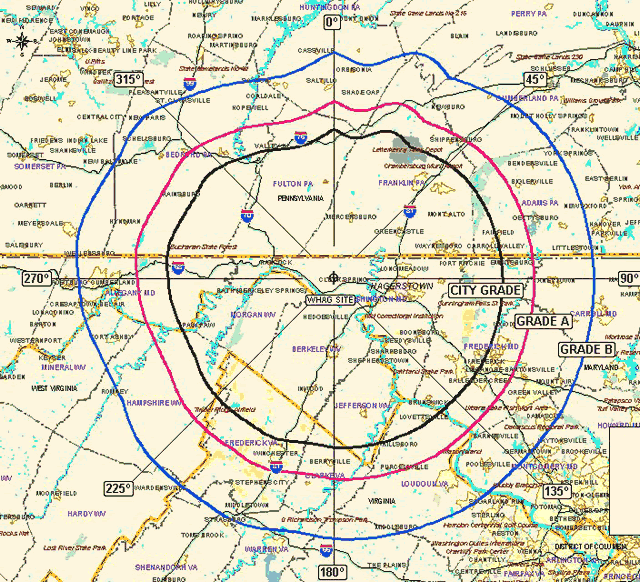
Predicted Contour Lines
Computed F(50,50) City Grade - 80 dBu, Grade A - 74 dBu and Grade B - 64 dBu.
An example of predicted contour lines of NTSC station WHAG-TV 25 Hagerstown MD...
Symbols/Abbreviations - General
Website Navigation
The Casey Media website is best viewed on Microsoft Edge Chromium 11 (or Newer), Google Chrome 80 (or Newer), Opera GX 8 (or Newer) and Mozilla Firefox 101 (or Newer): with a minimum screen resolution of 800x600 and minimum "color quality" display set at 24-bit. We recommend at least a display resolution of 1920x1080 and refresh rate of 60hz in order to properly load and display webpages...
Website Audio/Video
Most audio/video files and Internet streams on the Casey Media pages require a media player such as VLC Media Player or Windows Media Player.....
Some documents on Casey Media require the use of Adobe Acrobat Reader  to view.....